
Sex Offender Checks in Utah County
The official starting point for Utah County registry records is the Utah Bureau of Criminal Identification offender-registry gateway. It routes the public to the Utah Sex, Kidnap, and Child Abuse Offender Registry. The Utah County Sheriff registers people entering or leaving county confinement and handles people in county jurisdiction when another local agency or state Adult Probation and Parole is not responsible. That division of work matters. The public portal combines records gathered by more than one registration agency rather than serving as a sheriff-only list.
Prepare either a full or partial name or a Utah County location. The Utah County registry works best when those inputs are as precise as the known facts allow. A location search is useful for community awareness, while a name search is better when identity details are already known. Compare aliases, physical traits, residence entries, vehicles, and the listed registration status before treating two records as the same person. The registry warns that data supplied through registration can be incomplete or inaccurate. A missing result only means the record was not found through that search and those inputs.
Utah County Registry Terms Gate
Before any Utah County offender records appear, the Community Notification portal requires agreement to its terms. For Utah County users, that first screen is substantive. It explains that the information comes from registration records, that victim-identifying details are withheld, and that a listing does not prove a person will commit another offense. It also bars harassment, stalking, or threats toward a registrant or the registrant's family. A CAPTCHA may follow. The vendor gate prevented a reliable inspection of every radius choice, so no precise distance option should be assumed.
The BCI registry source shows the official route into that terms screen.
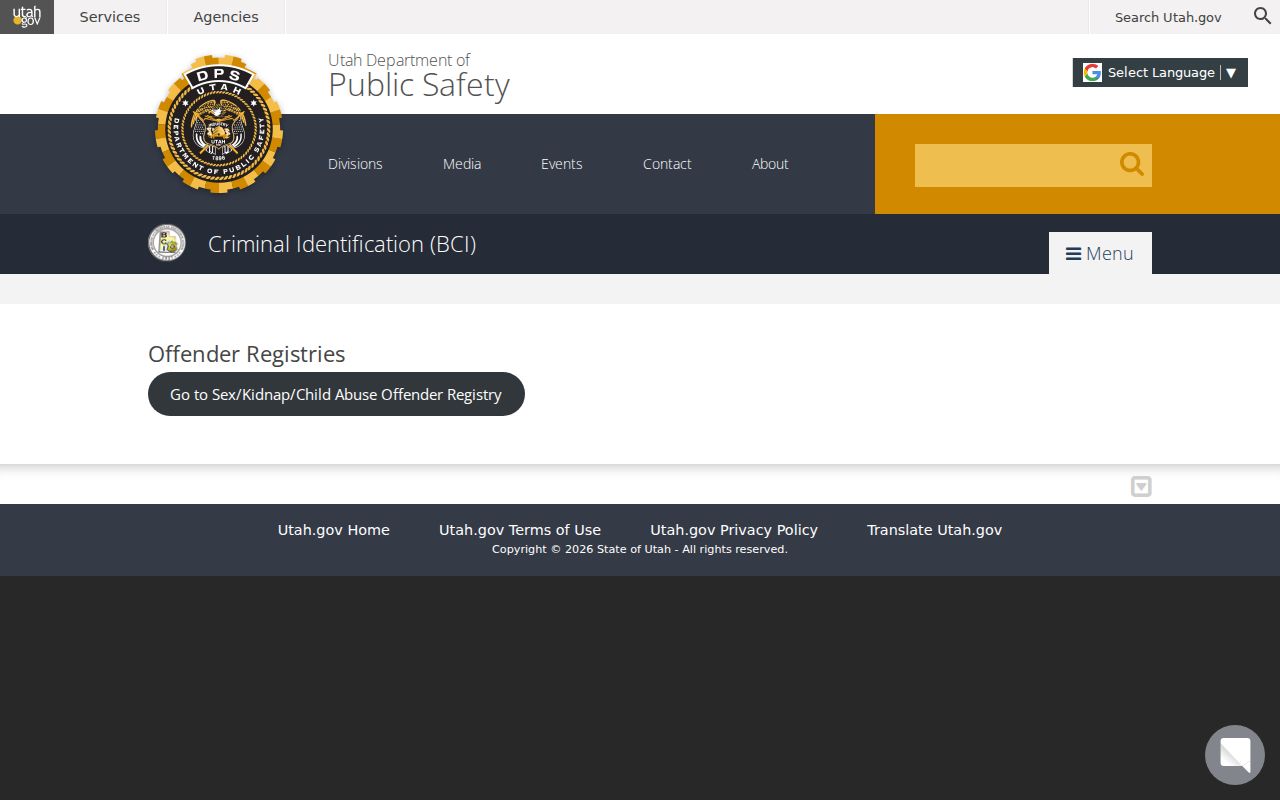
The captured gateway helps a Utah County searcher distinguish the state-authorized registry from unrelated commercial databases.
How to Search the Utah Sex, Kidnap, and Child Abuse Offender Registry
The Utah registry offers name and location paths for Utah County sex offender records. A Utah County name query should begin broadly, then narrow the inputs. Do not add an unverified radius or other field merely because another state's registry offers it. The official Utah controls documented in the research are enough for a careful search.
- Open the BCI gateway, continue to Community Notification, read the conditions, and check the required agreement box.
- Choose a location search with address, city, state, or ZIP, or enter last name, first name, and city for a name search.
- Review the returned list or map and compare the available identifiers. Similar names alone do not confirm identity.
- Open the profile, read residence, offense, status, and vehicle details, and contact the responsible registration agency if a current fact needs verification.
| Mode | Field or Control | Type | Search Note |
|---|---|---|---|
| Terms | Agree to terms | Checkbox | Required before continuing |
| Location | Address, City, State, ZIP | Text and dropdown | Utah is the default state |
| Name | Last Name, First Name, City | Text | Supports a person-focused search |
| Results | Search | Button | Returns list or map-style results |
| Notification | Proximity or email alert | Signup | Confirm current availability in the live portal |
A proximity or email-alert control should be treated as conditional until it appears in the live Utah portal. The inspected vendor gate did not support a sound claim about every Utah County option. If a search returns a possible match, preserve the profile details and contact the registration agency for a time-sensitive correction instead of relying on a screenshot alone.
Utah County and NSOPW Searches
A Utah County address search covers the state system, but it is not the best single channel when the person or location has ties beyond Utah. The Dru Sjodin National Sex Offender Public Website is the official federal search layer across participating jurisdictions. Use it after the Utah registry when a move, school, trip, family connection, or former residence crosses a state line. NSOPW does not replace the state profile. It points back to jurisdiction records and can expose a match that a Utah-only query could not reach.
The official NSOPW search provides the national comparison channel.
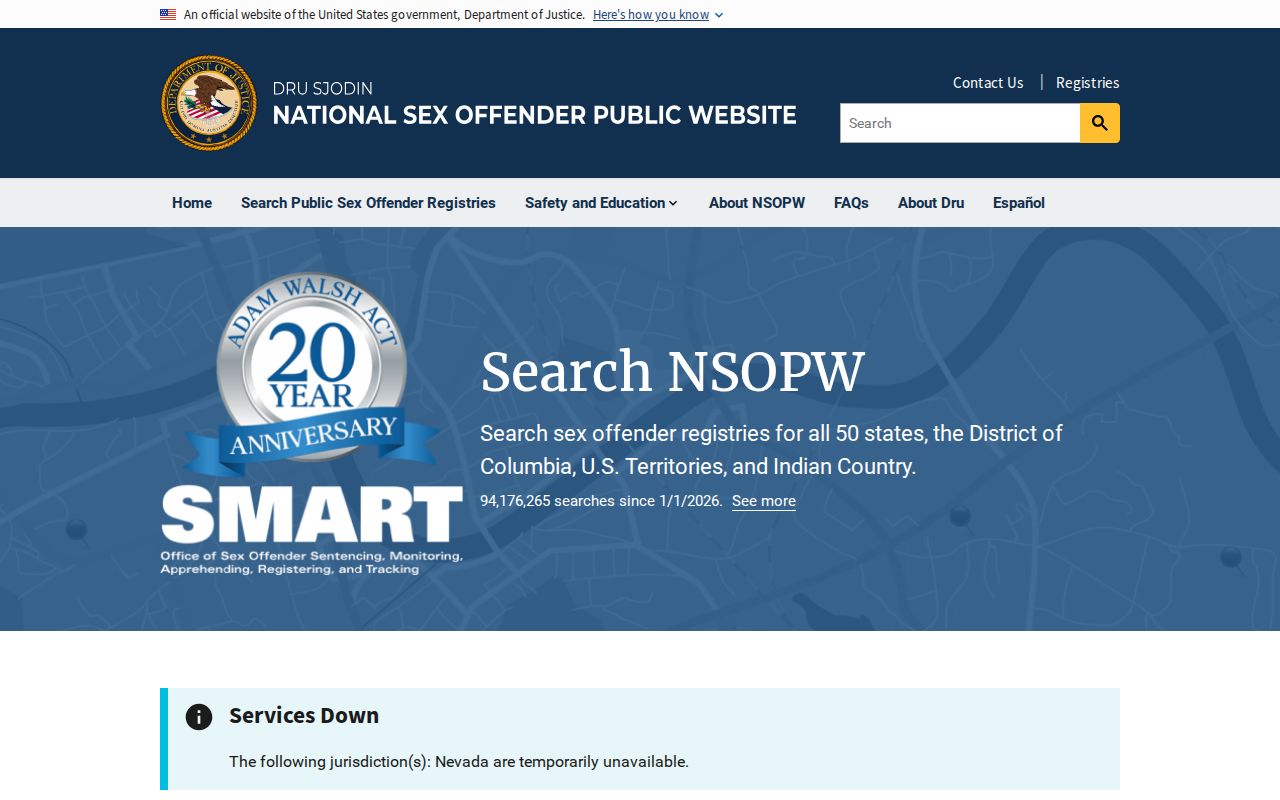
The national interface is most useful as a second search, followed by verification on the state record that maintains the profile.
Inside a Registry Profile
A Utah County registry profile can carry more identifying and location detail than a court docket, because its purpose is public notice. The current statute authorizes names and aliases, physical description, photographs, residences, vehicles, work or school locations, qualifying convictions, and status. Victim identity is not public. The live interface should be checked before expecting scars, tattoos, or exact conviction-date fields, since those items were not reliably confirmed during source inspection.
| Name and Aliases | Legal and other reported names used to compare identity |
|---|---|
| Physical Details | Date of birth, height, weight, eye and hair color, and a current photo |
| Residences | Primary, secondary, and temporary residence entries when applicable |
| Vehicles | Regularly used or owned vehicles, including make, model, color, year, and plate |
| Activity Locations | Utah school, work, vocation, volunteer sites, and professional licenses |
| Registry Basis | Registrable convictions or adjudications plus the current listing status |
For Utah County profile review, read these fields as a set. An address without a matching name, photo, and physical details is weak evidence of identity.
Utah County Registry Law Changed
Utah moved its offender-registration framework from the former Title 77, Chapter 41 structure into Title 53, Chapter 29 during 2025 and 2026. Current Utah County registry explanations should therefore use the new chapter. Old summaries may still show the former code location, an old department fee, or a broad federal tier shorthand. Those details should not be carried forward without checking the live law.
The migration changed where researchers find the rule, not the need to use official sources. Section 53-29-203 now supplies the main duration lists. Utah still distinguishes enumerated ten-year and lifetime obligations instead of assigning every public profile a simple Tier I, Tier II, or Tier III badge. That distinction matters in Utah County. Local registration staff, county confinement staff, and AP&P carry out their roles within that state framework.
The current Utah registry-duration statute displays the controlling categories.
The statute image anchors Utah County duration research to the current chapter rather than a stale Title 77 summary.
Utah Registration Levels and Requirements
Utah uses offense lists and sentence-based time rules. It does not publish a universal three-tier scale for all Utah County registry entries. For a standard ten-year category, the public description begins with the sentence and extends ten years after sentence termination. Lifetime offenses remain subject to registration for life. External-jurisdiction cases can follow the other jurisdiction's continuing period or Utah's applicable period. Some qualifying under-21, no-force lifetime cases may receive a court determination that reduces the period.
| Current Utah Category | Duration | Public Treatment |
|---|---|---|
| Section 53-29-203(1)(a) offenses | Sentence plus ten years after termination | Published when statutory public rules apply |
| Section 53-29-203(1)(b) offenses | Lifetime | Published when statutory public rules apply |
| External-jurisdiction registrant | External period if still required, otherwise Utah period | Handled under the applicable registration duty |
| Qualifying under-21 no-force case | Ten years after sentence termination if a court grants relief | Depends on the court determination |
| Certain offenses committed under age 18 | Maintained as required | Not publicly published, subject to exceptions |
Verification timing depends on the duty and supervising or registering authority. Utah County searchers should confirm it with the agency responsible for the individual profile.
Who Registers Utah County Offenders
In Utah County, registration responsibility follows custody, supervision, and residence. Utah County law enforcement registers people in its jurisdiction who are not under UDC Adult Probation and Parole. The Utah County Sheriff handles registration tied to entry into or release from county confinement. AP&P handles people under its state supervision. Trained and certified staff transmit address changes electronically, which lets the statewide portal reflect local work.
For a suspected mismatch, begin with the agency tied to the listed residence or supervision status. Utah County Sheriff's Office headquarters is at 3075 North Main Street in Spanish Fork, with the main line at 801-851-4000. BCI is the state registry gateway. Call 911 only for an emergency. A routine concern about possible noncompliance belongs with the responsible registration agency or BCI, supported by specific facts rather than assumptions drawn from a map point.
Utah County Sheriff
3075 N Main Street
Spanish Fork, UT 84660
801-851-4000
Utah County Registry Accuracy Limits
The Utah County registry search draws on a Utah system that says its information comes from offenders and cannot be guaranteed complete or accurate. That warning does not make the portal useless. It tells the reader how much weight to place on a hit. Compare the current photo, aliases, physical description, address type, vehicles, and registration status. Then ask the maintaining agency about a fact that affects a personal or family safety plan.
A no-result search also has limits. Spelling, a recent move, record update time, an out-of-state duty, or a statutory publication exception can affect what appears. NSOPW may help with the interstate issue. For Utah County residents, local staff can address a suspected reporting failure. Neither path should be used to infer that an unlisted person has no criminal past, because the Utah registry is limited to qualifying registration duties.
Note: A registry entry documents a statutory notice duty, not a prediction that the listed person will commit a future offense.
Community Notification and Lawful Use
Utah County registry information supports personal, family, and neighborhood awareness. Utah County families should use it to understand official notice data, confirm the responsible agency, and make a measured safety plan. Victim-identifying information remains redacted. Do not contact a registrant or household to test a profile, seek explanations, or enforce registration terms. Report a concrete concern to law enforcement or BCI and let the agency check compliance.
Registry misuse warning: The Utah registry terms prohibit using the information to harass, stalk, or threaten an offender or the offender's family. Misuse of registry information is a crime under Utah law.
Community notification is not permission for vigilantism. The safest response is a precise Utah County report that gives the location, observed fact, and relevant profile without publishing extra personal information.