
Checking Criminal History in Orem
Begin an Orem criminal records check by naming the document you need. The city police record is the source for an officer narrative or incident details. A city court channel is better for filed lower-level charges, hearings, and dispositions. The Utah County Sheriff holds booking and current-custody data when Orem officers take someone to the county jail. Xchange supplies public district and justice court history, while MyCase gives an eligible participant free access to that person’s own case.
Use this sequence to keep Orem records from different custodians separate:
- Ask Orem Police Records for the incident or arrest report created by the department.
- Use the Orem Justice Court calendar for a future appointment, then contact the clerk if the search is blank or history is needed.
- Use MyCase for your own case documents or Xchange for a public historical court search.
- Check the Utah County Sheriff channel for a county booking, remembering that online booking data has a publication delay.
- Request your own fingerprint-based Utah history from BCI when a statewide self-review is the goal.
The Orem city channel should remain the first stop for an Orem-created report. State and county tools do not reproduce the full officer narrative, and a police form does not return a court judgment.
Orem Jotform Record Choices
Orem separates general city records from police records. The city’s official records-request page routes users to distinct Jotforms, so a request for an Orem Police report should follow the police option. The police form is also available through the Orem Police records Jotform. Official inspection could not reliably expose the dynamic form’s field labels, fee, identification rule, or response time. Do not assume that an account, a flat price, or a set delivery date applies.
The most useful request still identifies the event as closely as the requester can: the type of record, approximate date, place, and known case number. Questions can go to policerecords@orem.gov or the records counter at 95 East Center Street. The counter is open Monday through Friday from 8:30 a.m. to 5:30 p.m. Orem Support Services includes Community Service Specialists who manage and disseminate department records.
The Orem records page shows the local request route in context.
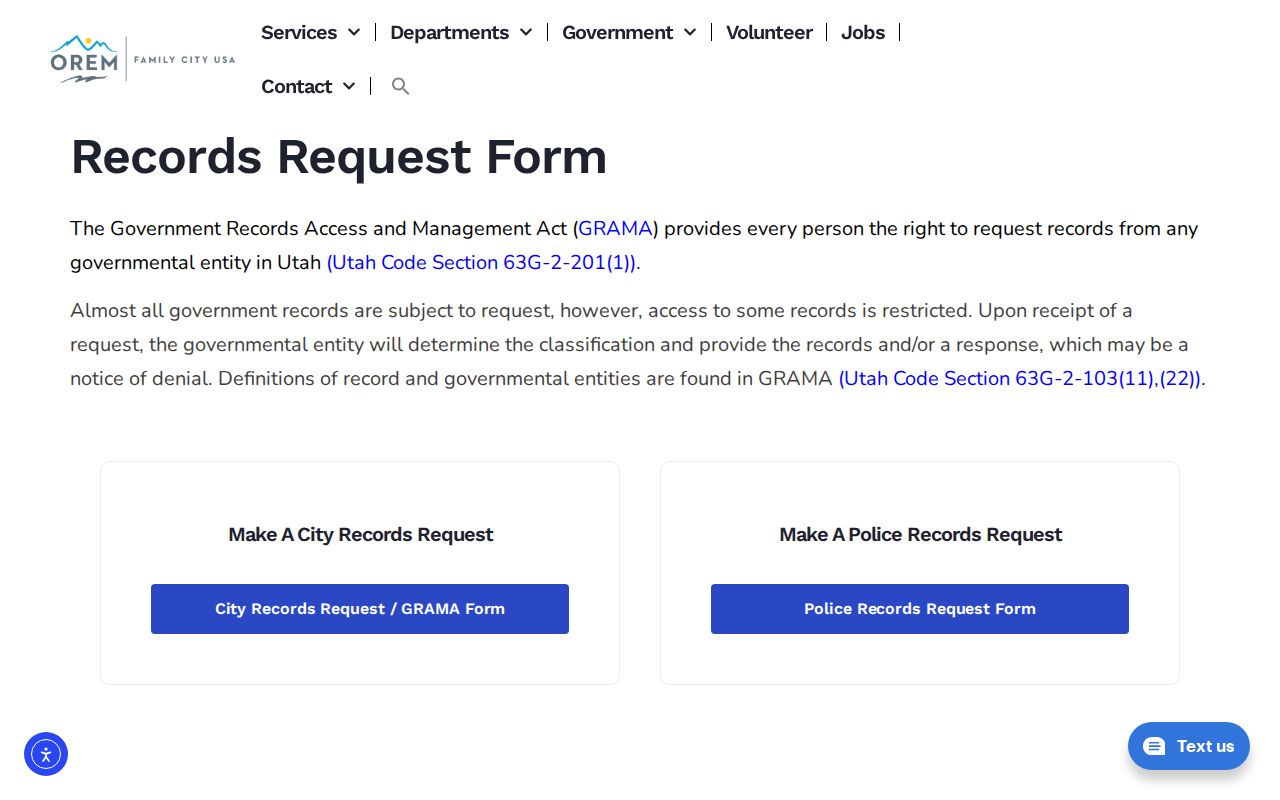
That page matters because it prevents an Orem police-report request from going to the general city-record channel.
Orem Police Department Records
Orem Police Records is at 95 East Center Street, Orem, UT 84057. The main police number is 801-229-7070, and the records email is policerecords@orem.gov. The unit can address records created by Orem officers, including eligible incident and arrest reports. Release remains subject to classification and redaction under Utah law, so an Orem record may omit protected information about victims, minors, witnesses, or an active investigation.
Orem evidence and property use a separate workflow. Orem lists evidence@orem.gov for pickup scheduling, but an evidence release is not a request for the police narrative. Likewise, online incident reporting creates a new report. It does not retrieve an older Orem criminal record. Keeping these three Orem tasks apart avoids sending a records question to the property custodian or opening a new incident submission by mistake.
Orem Police Records
95 East Center Street
Orem, UT 84057
801-229-7070
Monday-Friday, 8:30 a.m.-5:30 p.m.
policerecords@orem.gov
The official Orem Police page provides the department’s public-facing context.
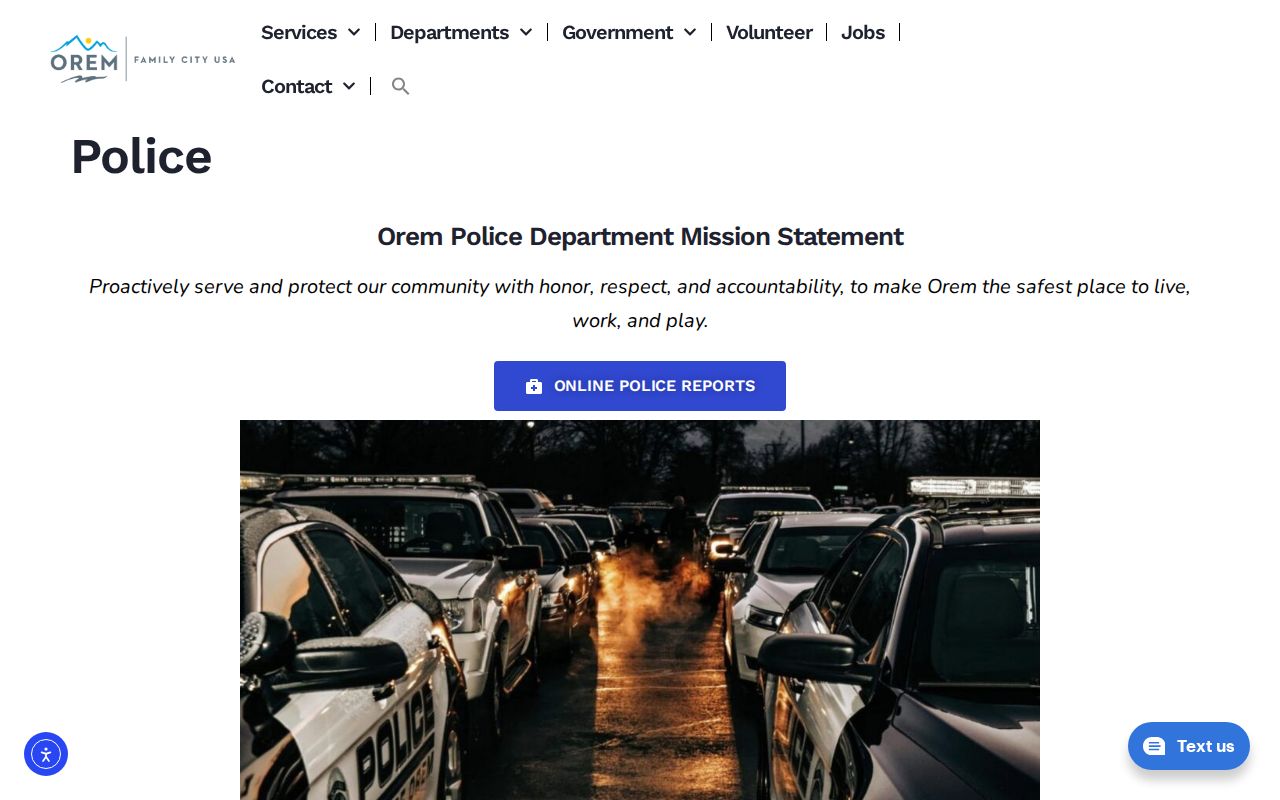
The department view reinforces that Orem police records begin with a city office, even when custody later shifts to the county.
Orem Dispatch and Report Custody
A call for service and a completed Orem police report may have different custodians. Metro Emergency Communications handles emergency calls and dispatch work for Orem, Provo, and Lindon. Orem Police then creates and maintains the officer’s narrative and related department file. Someone seeking audio, dispatch timing, or computer-aided dispatch material should describe that product precisely rather than asking only for a police report.
This Orem distinction matters when reconstructing an event. A dispatch record may show when help was requested and units were sent. The police narrative may document observations, statements, asserted probable cause, evidence, and an incident number. A court file later shows whether a prosecutor filed a charge and how the case ended. None of those records can stand in for the other two.
- Call for service
- A request or dispatch activity that may never become a crime report.
- Incident number
- The Orem Police identifier for its event file, not necessarily the court case number.
- Disposition
- The court outcome for a filed charge, such as dismissal, conviction, or acquittal.
Orem Arrests and Bookings
No official Orem city jail or city roster was identified. When an Orem arrest leads to county custody, the record trail moves from the police report to the Utah County Sheriff’s booking system. The Sheriff’s online Arrested Person Search publishes booking information after a 24-hour delay. A blank immediate search therefore does not prove that no Orem arrest occurred.
The Orem booking entry may include the booking number and date, arresting agency, intake charge, hold, bail, custody status, and release information. It is not the final criminal case. Initial booking charges may change after prosecutor review, and some Orem police contacts end in a citation rather than county booking. For a full county explanation of current roster limits and release codes, use the contextual Utah County arrest lookup.
When older booking information is no longer online, the Sheriff’s records process is the fallback. When the question concerns what an Orem officer alleged, request the creating police report instead. When the question is whether charges were filed, search the right court.
Note: An Orem arrest or booking entry records custody, not guilt, and should always be checked against the court disposition.
Orem Nine-Digit Calendar Search
The Orem Justice Court Calendar Search is a narrow local tool. Enter either a nine-digit Court Case number with no letters, such as the official example 201900001, or a last name, then select Apply. The calendar covers future appointments within one year and updates each day. A change made during the last 24 hours may not appear yet.
An Orem result can be sent by email as a reminder. A blank result means only that no appointment was found under those inputs in the covered future window. It does not establish that a person has no Orem court record. Contact the clerk when a date is urgent or use MyCase or Xchange when the goal is case history rather than a schedule.
| Orem court channel | Best use | Key limit |
|---|---|---|
| Calendar Search | Public future appointment | One-year window; daily refresh |
| MyCase | Your own balances, dates, and documents | Email, case number, and government ID required |
| Xchange | Public historical district and justice cases | Paid online; free at many court terminals |
The calendar source displays the two-field Orem search.
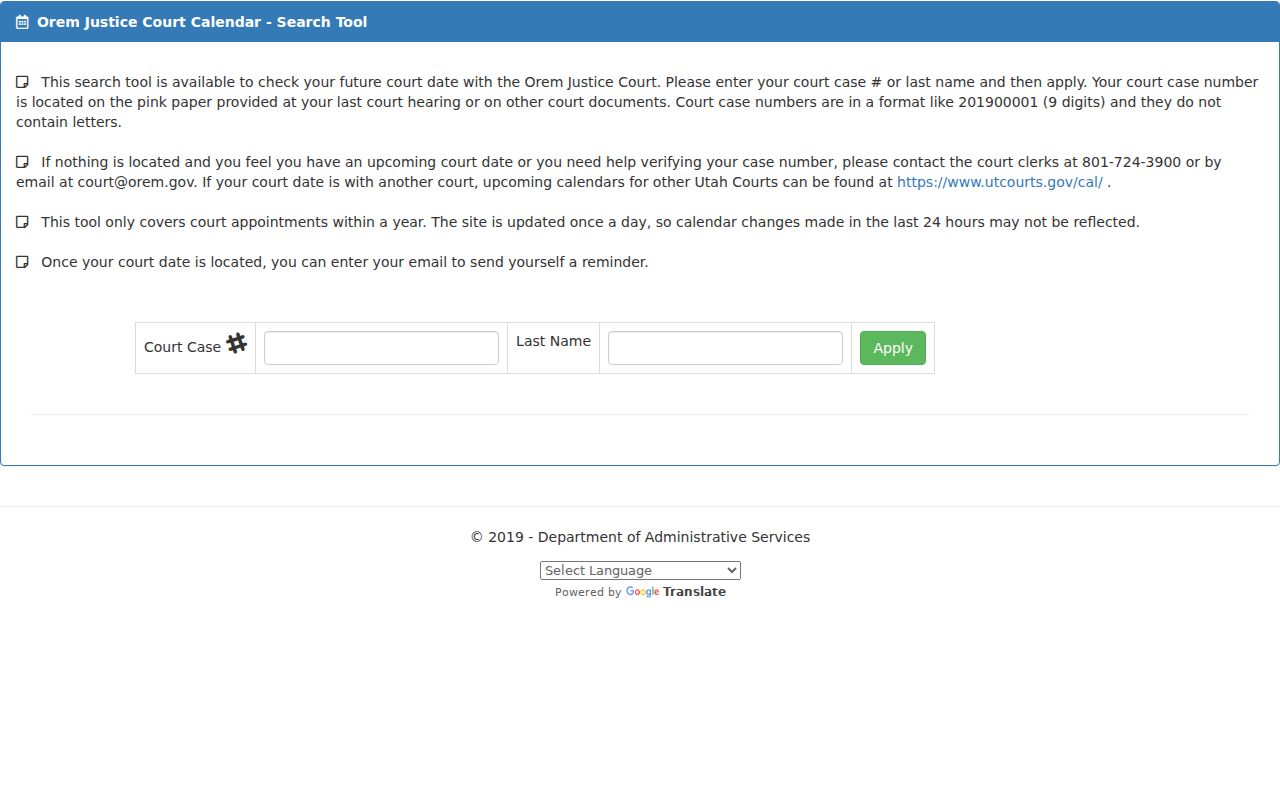
The simple interface is useful for dates, but its narrow scope is why Orem historical records require another channel.
Municipal Court Records in Orem
Orem Justice Court is at 97 East Center Street, Orem, UT 84057. Call 801-724-3900, text 801-229-7000, or email jcorem@utcourts.gov. Court-specific information should control over the 56 North State address that appears in some general city footers. Orem Justice Court handles the lower-level city matters within its authority, while felonies and class A misdemeanors go to the Fourth District Court.
A public Orem court record may show the case number, parties, charge level, hearings, plea, disposition, judgment, and orders, subject to judicial access rules. Calendar data alone is not the docket. For an older or missing file, contact the clerk or use the Utah Courts record-request route. A certified disposition is the better source when correcting an incomplete state criminal history.
| Court Name | Orem Justice Court |
|---|---|
| Case Types Heard | City lower-level criminal, ordinance, traffic, and other justice-court matters within its jurisdiction |
| Case Lookup Channel | Orem Calendar Search for future dates; MyCase for a participant; Xchange or clerk for public history |
| What the Docket Shows | Case identifiers, filed charges, hearings, pleas, disposition, judgment, and orders when public |
| Copies & Fees | Request through the court; current Utah Courts copy and certification fees apply |
Orem Calls Are Not Crimes
Orem reported 60,800 calls for service in its city review, but that count cannot be compared as if it were the 4,184 NIBRS offenses reported by BCI for 2024. Calls include requests for help and activity that may never yield a crime report. NIBRS uses a standardized offense framework. An incident can also contain more than one offense, so neither figure is a count of people, arrests, charges, or convictions.
BCI listed an Orem agency population of 94,571 and an offense rate of 44.24 per 1,000. The reported offense groups were 897 crimes against persons, 2,375 property offenses, and 912 society offenses. Those figures add local context but do not identify anyone and should not be used to infer that a named person has an Orem criminal record.
The city’s 2022-23 review also warns that internal counts are preliminary, may lag, and are not official UCR rates. For a standardized comparison, consult the BCI Crime in Utah dashboards. Keep the report year and definition attached whenever citing an Orem number.
The official Census Orem profile supplies population context separate from police counts.
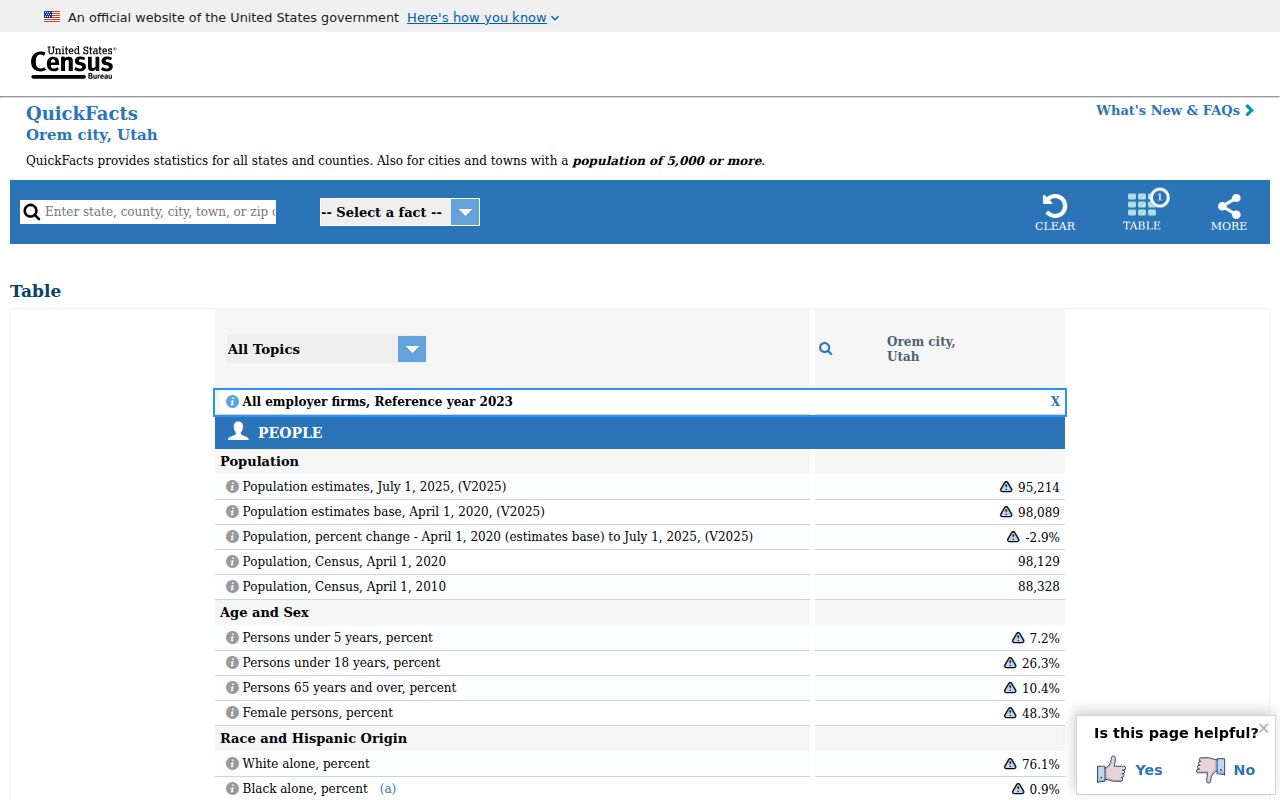
Population data helps explain the scale of Orem services without turning calls or offenses into a person-level record search.
Where Orem Records Go
An Orem event can split into several files. Orem Police keeps the incident record. If custody occurs, the Utah County Sheriff creates booking identifiers, fingerprints, holds, and release data. The city prosecutor or County Attorney decides what to file based on charge level. Orem Justice Court handles eligible city matters, while Fourth District Court handles all felonies and class A misdemeanors.
Record flow: Orem Police Department › Orem Justice Court or Fourth District Court › Utah Department of Public Safety, Bureau of Criminal Identification
Orem court staff enter public case information into CORIS, which feeds Xchange after entry. Arrest fingerprints can connect a cycle to the state repository, while later court dispositions should flow back into criminal-history systems. Reporting lag or identity matching can leave a BCI record incomplete. The originating Orem or district court disposition is the best support for a correction.
Orem Video Court Record Help
Most Orem Justice Court hearings use video. That fact makes the calendar valuable, but it does not make a calendar entry a complete record. Confirm the date and access details with the court when a setting is close, especially because last-day changes may be absent from the daily calendar refresh.
Orem also provides a Spanish-assistance request path. Court staff state that they will contact a requester within one to two business days. This is help with court access, not a substitute for filing a record request or checking a disposition. Email jcorem@utcourts.gov or use the court phone and text channels for case-specific scheduling questions.
MyCase remains the stronger tool for an eligible participant who needs balances, payments, upcoming hearing times, and available documents. Registration uses a frequently checked email address, a case number, and government identification. A member of the public searching Orem case history should use Xchange or the clerk instead.
Public Access Rules in Orem
Orem Police records follow Utah’s Government Records Access and Management Act, while Orem court records follow the judiciary’s access rules. Under GRAMA, a person may request a public record, but the city need not create a new compilation and may withhold or redact private, controlled, or protected material. A subject or person with qualifying authority can have rights to specified nonpublic material that the general public lacks.
Sealed, expunged, and juvenile matters do not appear in public Xchange results. Personal identifiers and information about victims or minors may also be restricted. A denial or partial response should be read with its classification reason rather than treated as proof that the Orem event never occurred.
Key Statutes:
Utah Code §63G-2-201 establishes access to public government records while recognizing protected classes.
Utah Code §63G-2-202 governs access to specified nonpublic records by a subject or authorized requester.
Utah Code §53-10-108 limits dissemination of BCI criminal-history information.
Orem Records Across Nine Districts
Orem grew from the Provo Bench farm and fruit-orchard communities and took its name from Walter C. Orem. Its nine planning districts group neighborhoods such as Canyon View, Orchard, Cascade, Sharon Park, Heatheridge, Timpview, Geneva Heights, Stonewood, Sunset Heights, Lakeview, and Cherry Hill. These planning areas add place context, but they do not create separate police or court record systems.
The Orem Where I Live tool can produce parcel-based PDFs with neighborhood, zoning, land use, school, crime context, and public-official information. It is not a person search, a police report portal, or an Orem criminal history database. Use it to understand location. Use Orem Police Records for an incident file and the court channels for a case.
The official Orem police request form is the direct city route shown in the captured source.
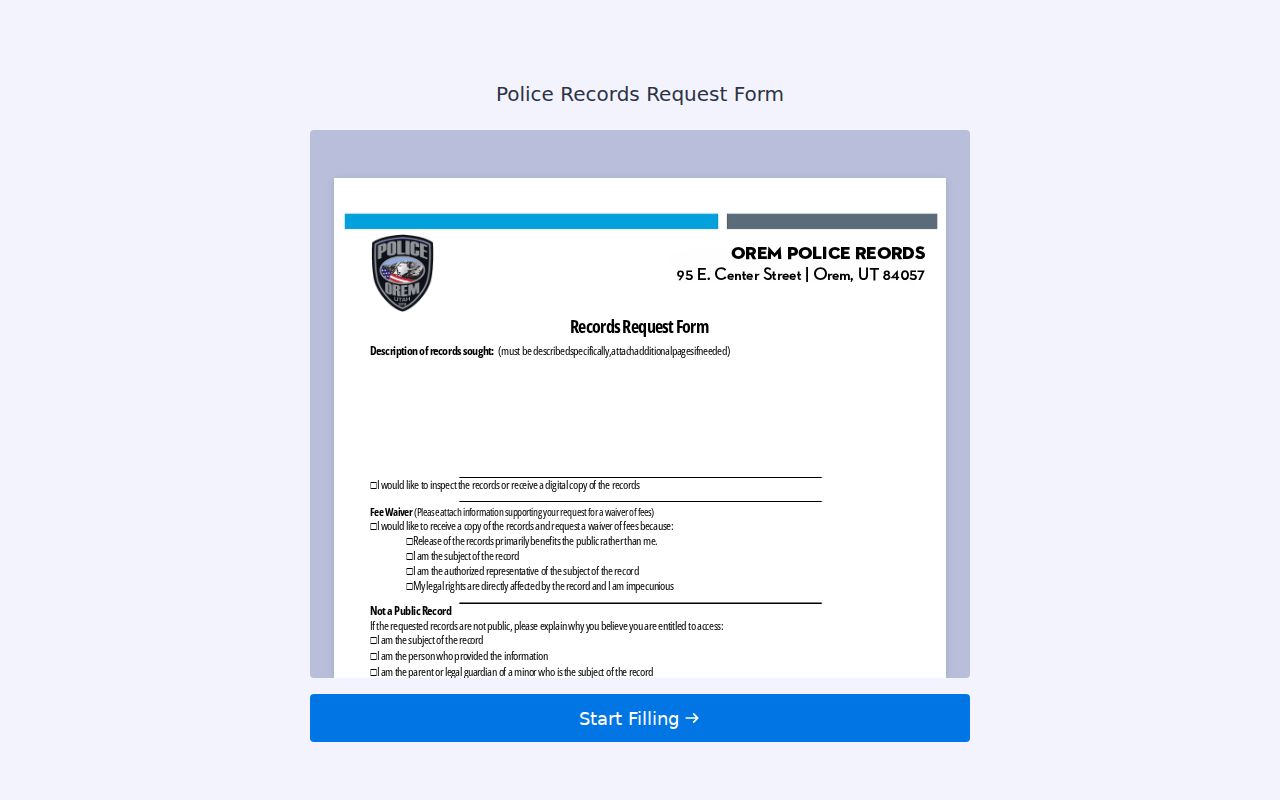
Its placement in the city workflow helps keep neighborhood context apart from the request for an actual Orem police record.