
Checking Criminal History in Lehi
A Lehi criminal record check works best as a source-by-source search. Lehi Police can release eligible incident and arrest records that its officers created. Lehi Justice Court supplies its own court schedule and files. The Utah County Sheriff becomes relevant if Lehi police transfer a person to county custody. MyCase, Xchange, and BCI each answer a different state-level question and should be used only after the Lehi record type is clear.
Follow five practical steps:
- Submit a focused Lehi Police GRAMA request for the city incident or arrest report.
- Use the city-linked court calendar for a hearing date, then contact the Lehi clerk when the listing is missing or history is needed.
- Open MyCase for your own eligible case or Xchange for a public district and justice court search.
- Check the Utah County Sheriff system when the event included county booking or current custody.
- Use BCI Right of Access with fingerprints for your own statewide Utah criminal history.
A single blank search is not a statewide clearance. Spelling, timing, court scope, record classification, and the lack of a county booking can all affect what a Lehi query returns.
Lehi GRAMA Record Form Fields
Lehi publishes an unusually detailed Police GRAMA request form. It asks for the requester’s name, address, phone, and email, plus whether the requester wants to inspect records or receive copies. The form also asks for an authorized cost ceiling, which lets the city know how much work may proceed before it must contact the requester.
The Lehi record description can include the case number, address, date, names, and date of birth. Entitlement choices cover the record subject, information provider, an authorized requester, or another claimed basis with an explanation. Separate spaces support an expedited Lehi request and a fee waiver. The requester dates and signs the form before submitting it to Lehi Police Records.
| Requester | Name, address, phone, and email |
|---|---|
| Delivery Choice | Inspect the record or receive copies |
| Record Details | Case number or description with address, date, names, and date of birth when known |
| Cost Control | Maximum amount authorized before further contact |
| Special Grounds | Entitlement, expedited handling, and fee-waiver support |
Lehi Police Department Records
Lehi Police Records is at 128 North 100 East, Lehi, UT 84043. Call 385-201-1005, fax 385-201-1006, or email lehipolicerecords@lehi-ut.gov. The unit’s posted counter hours are Monday through Thursday from 7:30 a.m. to 5:30 p.m. It handles requests for eligible Lehi police material, subject to GRAMA classification, redaction, and fee rules.
Lehi Coplogic serves a different purpose. It submits a new qualifying incident and does not retrieve an old Lehi police report. General Lehi records also use a separate Open Records Portal that routes non-police requests to the Recorder. Questions about that general route go to 385-201-1000 extension 2524. Directing police, general city, and new-incident tasks to their own channels prevents delay.
Lehi Police Records
128 North 100 East
Lehi, UT 84043
385-201-1005
Fax: 385-201-1006
Monday-Thursday, 7:30 a.m.-5:30 p.m.
The official Lehi Police page identifies the department and its city role.
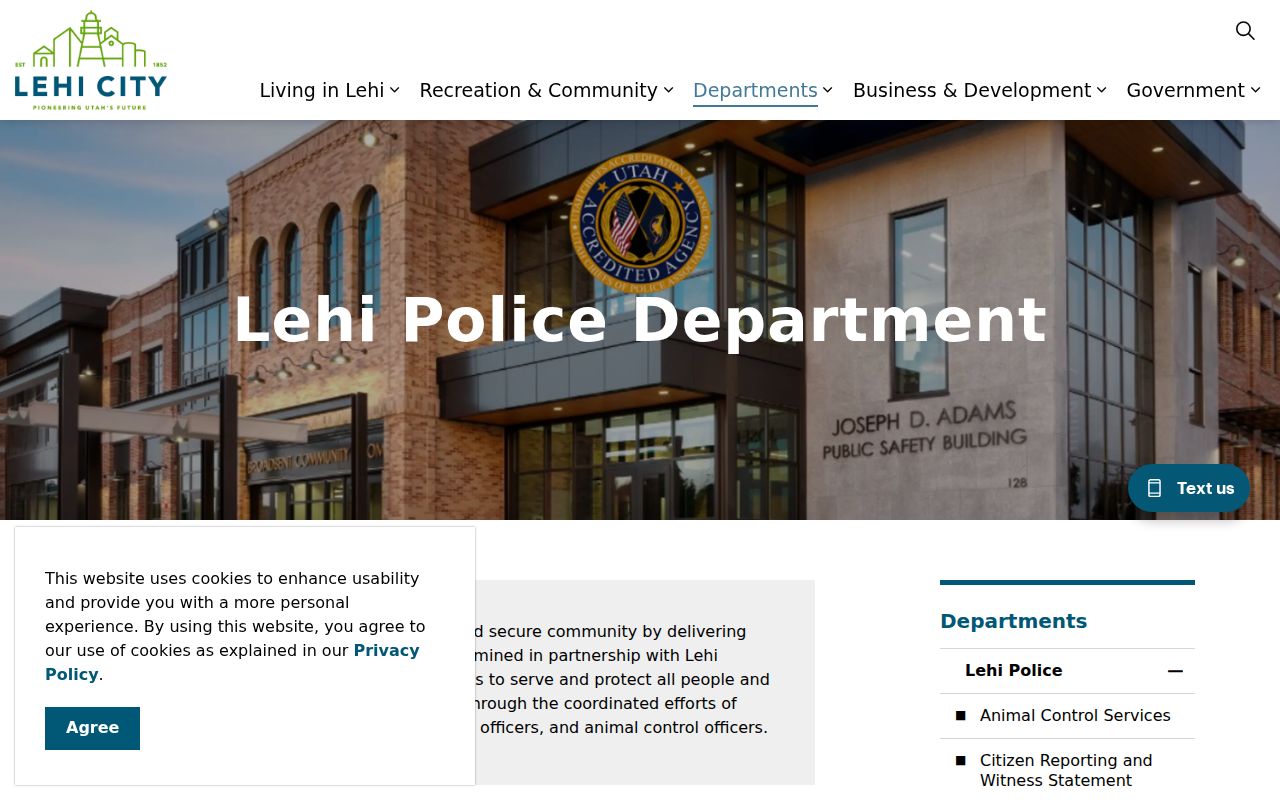
The department source confirms that Lehi-created police records begin with the city even when later records move elsewhere.
Lehi Records Start at $25
The printed Lehi police schedule sets a single record at $25 or $0.25 per page, whichever is greater. A color-photo page costs $5. A drive, CD, or DVD costs $30. Audio and video work can also carry the actual employee labor needed for review and redaction, which can make media requests far more costly than paper.
Lehi estimates five minutes of employee redaction time for each recorded minute. That five-to-one Lehi estimate is vital when requesting long body-camera files. Narrowing the date, time, location, involved event, and desired segment can reduce needless review. The cost ceiling on the Lehi GRAMA form gives the requester another way to control expense before staff complete a large job.
| Lehi police record item | Posted amount |
|---|---|
| Single record | $25 or $0.25 per page, whichever is greater |
| Color photograph page | $5 per page |
| Drive, CD, or DVD | $30 |
| Media review and redaction | Actual employee labor; estimate of five minutes labor per recorded minute |
A fee waiver may be requested with supporting reasons, but it should not be assumed. Ask the Lehi records unit for an estimate when the requested file includes substantial video or audio.
Lehi Arrests and Bookings
No official Lehi city jail was identified. When Lehi Police makes a custodial arrest that leads to Utah County booking, the Sheriff creates a separate Lehi jail record. The county search may show Lehi booking identifiers, the arresting agency, intake charges, holds, bail, custody status, and release information after its 24-hour publication delay.
Not every Lehi police case produces a jail entry. A citation or noncustodial event may never appear in the Utah County roster. Even when booking occurs, the listed charge can differ from the charge a prosecutor later files. Search Lehi Justice Court or Fourth District Court to determine whether prosecution followed, and read the disposition rather than relying on the arrest entry.
The city report remains the right source for the Lehi officer narrative. The Sheriff is the source for county intake. The court is the source for filed charges and outcome. The broader Utah County criminal court cases resource explains the district and justice court split without turning the Lehi page into a county-wide account.
Note: A Lehi arrest is not a conviction, and a blank county roster may reflect timing, citation, release, or another custody path.
Lehi Calendar, MyCase, and Clerk
Lehi links to a Utah Courts calendar prefiltered for Lehi court location 2533J, the criminal calendar type, and today’s date. It is a schedule, not a historical docket. Use it to check a listed Lehi setting, but do not treat a blank day as proof that no Lehi case exists. Contact the clerk when a date is urgent or a result seems incomplete.
MyCase is the free Lehi participant route for an eligible person’s own case. It can show balances, payments, upcoming dates, and available documents after registration. Xchange is the public search for Lehi district and justice court case history. Public web use is paid, while free Xchange terminals are available at most district courthouses and at the Utah State Law Library.
- Calendar
- A list of scheduled settings, not the full Lehi case history.
- MyCase
- Authenticated access for an eligible participant to that person’s own case.
- Xchange
- Public CORIS summary access for Utah district and justice court matters.
- Clerk request
- The fallback for missing, older, or copy-specific Lehi court records.
Municipal Court Records in Lehi
Lehi Justice Court is at 154 North Center Street, Lehi, UT 84043. Its phone is 385-201-1090, fax is 801-768-8405, and email is JCLehi@utcourts.gov. The court’s city pages address criminal cases, traffic, citations, mandatory appearances, forms, and a traffic-school plea-in-abeyance option. A plea in abeyance holds a plea subject to conditions and possible later dismissal; it is not the same as an immediate conviction or acquittal.
Lehi Justice Court is not the destination for every case that begins with Lehi Police. Fourth District Court hears all felonies and class A misdemeanors. Juvenile matters follow a separate, generally nonpublic path. When searching a public Lehi record, use charge level and age to choose the likely court, then verify the filed case rather than inferring jurisdiction from a police or jail code.
| Court Name | Lehi Justice Court |
|---|---|
| Case Types Heard | Eligible city criminal, traffic, citation, and other justice-court matters |
| Case Lookup Channel | Prefiltered Utah Courts calendar for schedule; MyCase for an eligible participant; Xchange or clerk for public history |
| What the Docket Shows | Case number, filed charges, hearings, plea, disposition, judgment, and public orders |
| Copies & Fees | Request from the court under the current Utah Courts fee schedule |
Lehi Calls and Offenses Differ
Lehi Police reported more than 41,000 calls, 8,143 stops, 4,610 citations, 2,477 crashes, 1,514 investigations, and 3,011 evidence items. Each count measures a different kind of work. They cannot be added into an arrest total or treated as the number of people with Lehi criminal records.
The same Lehi caution applies to BCI’s standardized 2024 data. BCI listed an agency population of 95,189, with 2,021 NIBRS offenses and a rate of 21.23 per 1,000. The Lehi offense groups were 502 against persons, 1,090 against property, and 429 against society. An NIBRS incident can include multiple offenses, and an offense is not the same as a stop, citation, investigation, charge, or conviction.
Lehi’s citation categories further show the problem with merging counts: 1,629 moving, 24 nonmoving, 37 parking, 683 registration, and 1,047 warnings. The crash figures also have distinct categories. Use the official BCI dashboards for standardized context, and use police or court records when the question concerns a specific event.
Where Lehi Records Go
A Lehi event can produce several official records. Lehi Police creates the incident file and may collect evidence. A custodial event can create a Utah County booking. A city or county prosecutor then reviews the case, and the proper court receives any filed charge. Fingerprints and reported dispositions can later contribute to the Utah state repository.
Record flow: Lehi Police Department › Lehi Justice Court or Fourth District Court › Utah Department of Public Safety, Bureau of Criminal Identification
This Lehi flow is not automatic proof that each stage occurred. A police investigation may close without a prosecution. A prosecutor may choose a different charge. A Lehi court may dismiss or acquit. BCI Right of Access compiles a fingerprint-supported state history for the subject, but it is not a public name search and can require a record challenge when a disposition is incomplete.
Lehi Records Reach Three Prosecutors
Lehi’s annual report offers a rare view of case routing. Police records staff disseminated 1,857 cases to prosecutors: 461 to the Utah County Attorney, 1,217 to the City Prosecutor, and 179 to Juvenile Court. Those figures show why an agency name or jail code cannot establish which court ultimately holds a filed matter.
Charge level and the person’s age influence the route. The City Prosecutor handles matters within the city justice framework. The County Attorney prosecutes district-level criminal cases, including felonies and class A misdemeanors. Juvenile Court records are generally outside public Xchange access. When a Lehi Justice Court search is blank, the next step is not to conclude that the event disappeared. Check the proper district or juvenile channel based on known facts.
The three-way split also separates investigation from prosecution. Dissemination means police sent a case for review. It does not mean the prosecutor filed every allegation or that a court entered a conviction. Only the court docket and disposition answer that final question.
Public Access Rules in Lehi
Lehi Police applies the Government Records Access and Management Act to agency records. GRAMA provides a right to inspect public material, but the city need not create a new record and may classify parts as private, controlled, or protected. Victim, minor, witness, personal-identifier, and active-investigation content may be withheld or redacted. A person requesting specified nonpublic material can be asked to show status or authorization.
Lehi court records follow judicial access rules instead of the police GRAMA form. Sealed, expunged, and juvenile cases are absent from public Xchange results. If the goal is a court document, send the request to the court that holds it. If the goal is the officer narrative, use Lehi Police Records. BCI controls fingerprint-based statewide history under a separate dissemination statute.
Key Statutes:
Utah Code §63G-2-201 grants access to public records while preserving statutory classifications.
Utah Code §63G-2-202 addresses access by the subject and other authorized requesters.
Utah Code §53-10-108 limits release of BCI criminal-history records.
Lehi Record Geography Since 1852
Lehi’s official history calls it Utah’s sixth-oldest city. Its names moved from Sulphur Springs to Snow’s Springs, Dry Creek, and Evansville before incorporation as Lehi in 1852. The city sat along the Overland Stagecoach, Pony Express, and Transcontinental Telegraph routes between Utah Lake and the Oquirrh and Wasatch ranges. Main Street, Broadbent’s, Roller Mills, the Pioneer Monument, and the old sugar-factory smokestack remain local reference points.
That history helps with older location-based and genealogy research, but today’s police and court channels remain the sources for modern Lehi criminal records. Records more than 50 years old may have transferred to Utah State Archives. Confirm with the originating office before assuming that a city counter still holds an early file.
Modern population growth also affects scale. The official 2024 incorporated-place estimate ranks Lehi third in Utah County at 93,446 residents. That estimate is separate from the police agency population used in BCI offense rates. The Census incorporated-place estimates provide the demographic source.
The Census source gives Lehi growth context without confusing population estimates with calls, offenses, arrests, or court cases.