
Utah County Criminal Court Cases
Utah County criminal court cases split by offense level. The Fourth Judicial District receives every felony and class A misdemeanor filed in the county. The Utah County Justice Court hears most county class B and class C misdemeanors, infractions, ordinance cases, and traffic matters within its area. City justice courts may hold similar lower-level cases filed by municipal prosecutors. The court, not the arresting agency, keeps the docket, charging papers, rulings, judgment, and sentence. That division matters because a booking at the Utah County Jail does not reveal which charge a prosecutor later filed or where the case ended.
The Provo Courthouse for the Fourth District is at 137 North Freedom Boulevard in Provo. Utah County Justice Court is at 151 South University Avenue, Suite 3300, and can be reached at 801-851-7200 or jcutahco@utcourts.gov during its posted weekday hours. A Utah County court case number is the most exact key, but numbers are not unique across the whole state. Pair the number with the court location and case type before treating a result as the right Utah County criminal case.
Xchange Opens Utah County Cases
Utah Courts describes Xchange as the public search service for district and justice court information entered in CORIS, the Utah Courts Information System. Utah County district coverage is generally complete from the end of 1998. Justice court adoption and conversion dates vary, and older converted Utah County case records may be sparse. Utah County Xchange results omit sealed and expunged cases, juvenile delinquency, child-welfare matters, and termination cases.
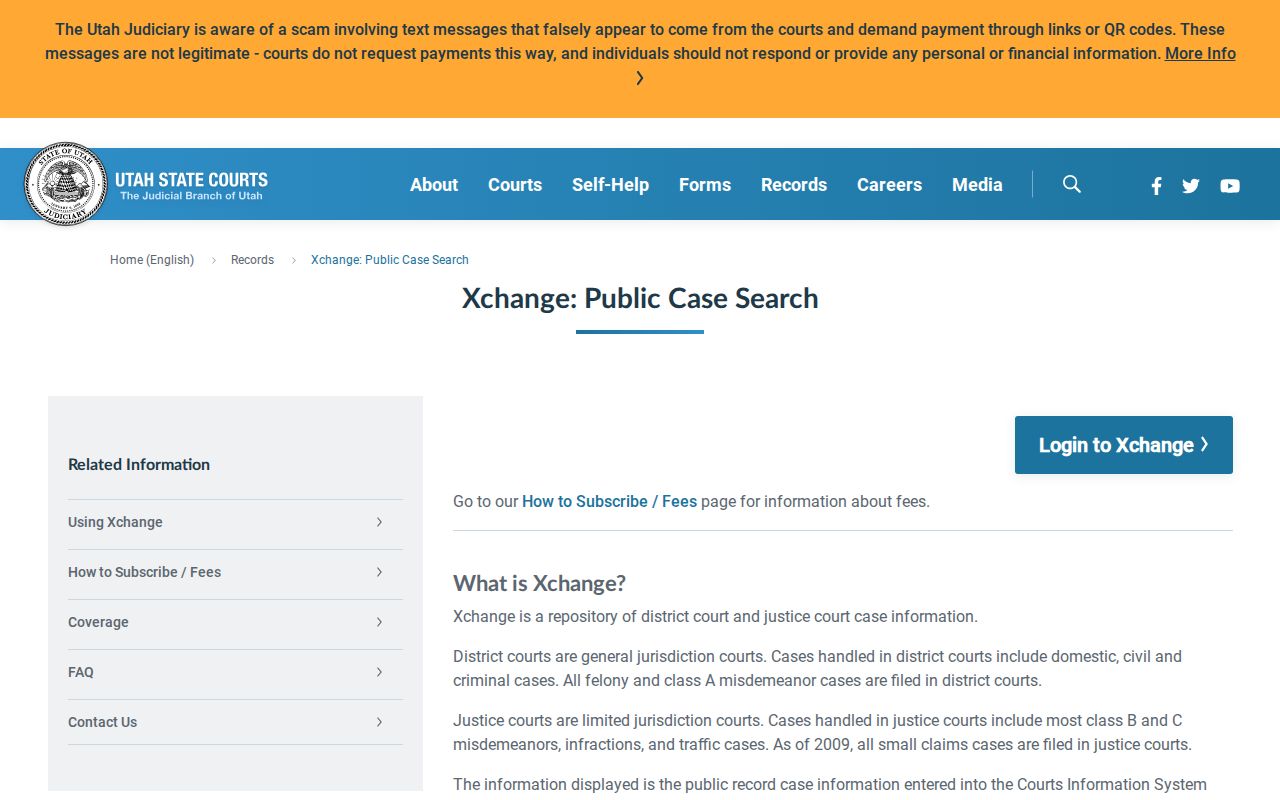
The captured official overview helps distinguish public court summaries from BCI fingerprint-supported criminal history. Xchange is available through a paid web account, while public terminals at most district courthouses and the Utah State Law Library offer free access. The Xchange registration page currently advertises a one-time option, subscription pricing, billable searches, and document charges.
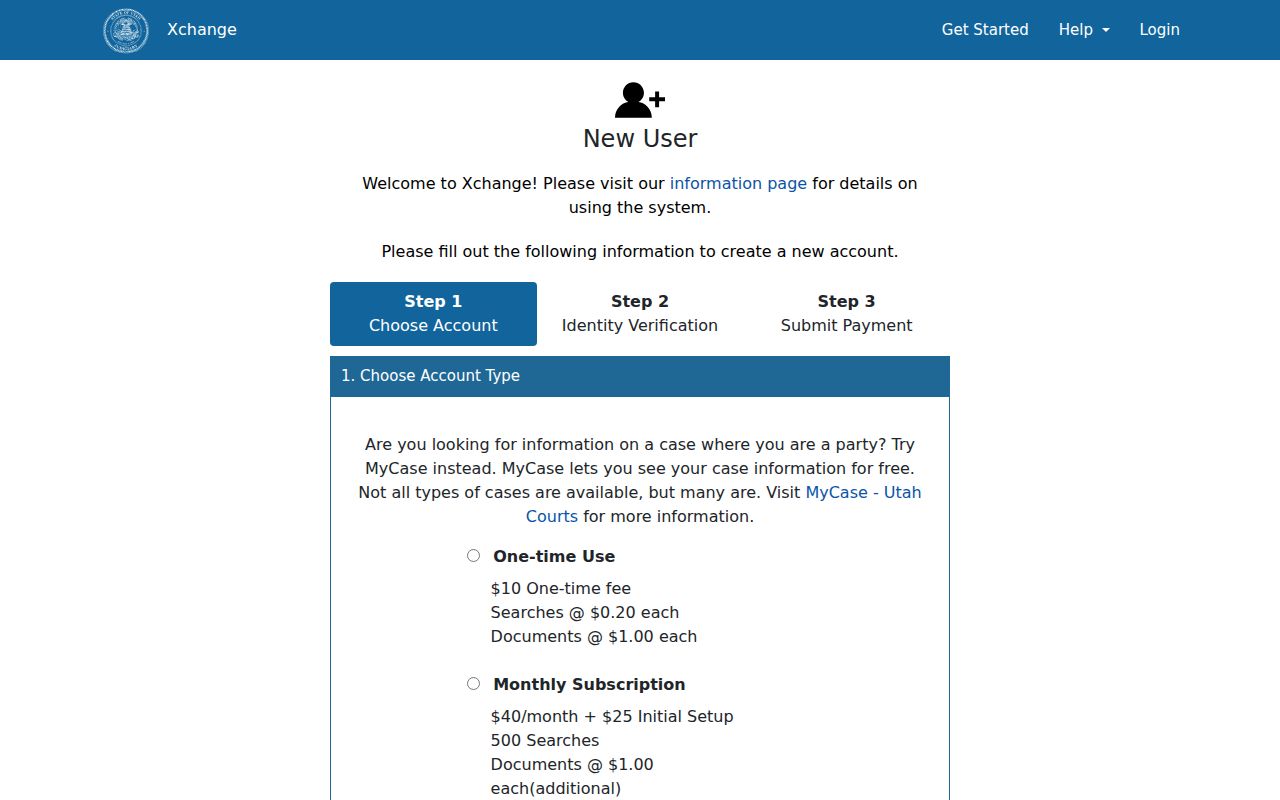
The registration image shows why a courthouse terminal can be useful for a reader who needs several Utah County court searches without a paid online account.
Searching Utah County Case Records
Start a Utah County case search with enough data to separate people who share a name. The official Xchange help material explains both the search controls and results. A first-name asterisk can find variations and middle-initial entries. Citation and case numbers can return more than one item, so add a court, county, filing range, or case type when possible. Results stop at 500, which makes broad common-name searches hard to review.
- Choose District Court, Justice Court, or both, then select all cases or judgments.
- Enter the case number when known. Otherwise use the party name as it appeared in the original filing.
- Narrow the Utah County case search by birth date, court, case type, citation location, or filing range.
- Open the case number and read charges, history, hearings, judgments, and disposition rather than relying on the result row.
- Purchase an available district filing or ask the originating clerk for a copy or certified record when proof is needed.
| Field Label | Type | Required | Notes |
|---|---|---|---|
| Jurisdiction | Selection | Unspecified | District Court, Justice Court, or both |
| Search Type | Selection | Unspecified | All court cases or judgments only |
| Case Number | Text | Optional | Not unique statewide; first two digits show filing year |
| Last Name or Company | Text | Search-dependent | Spelling follows the original filing |
| First Name | Text | Optional | An asterisk finds variations and middle initials |
| Case Type and Scope | Selection | Optional | Limit by code, statewide, county, or court |
| Birth Date | Date | Optional | Often present for criminal defendants |
| Citation Number | Text | Optional | Narrow with the citation location |
Note: A missing result means only that the record was not found in this channel under those inputs.
Free Utah County Case Access
Utah County readers who do not need remote access can use a free public Xchange terminal at most district courthouses. Call before travel to confirm availability. The official Provo courthouse page identifies the Fourth District location serving Utah County criminal court cases.
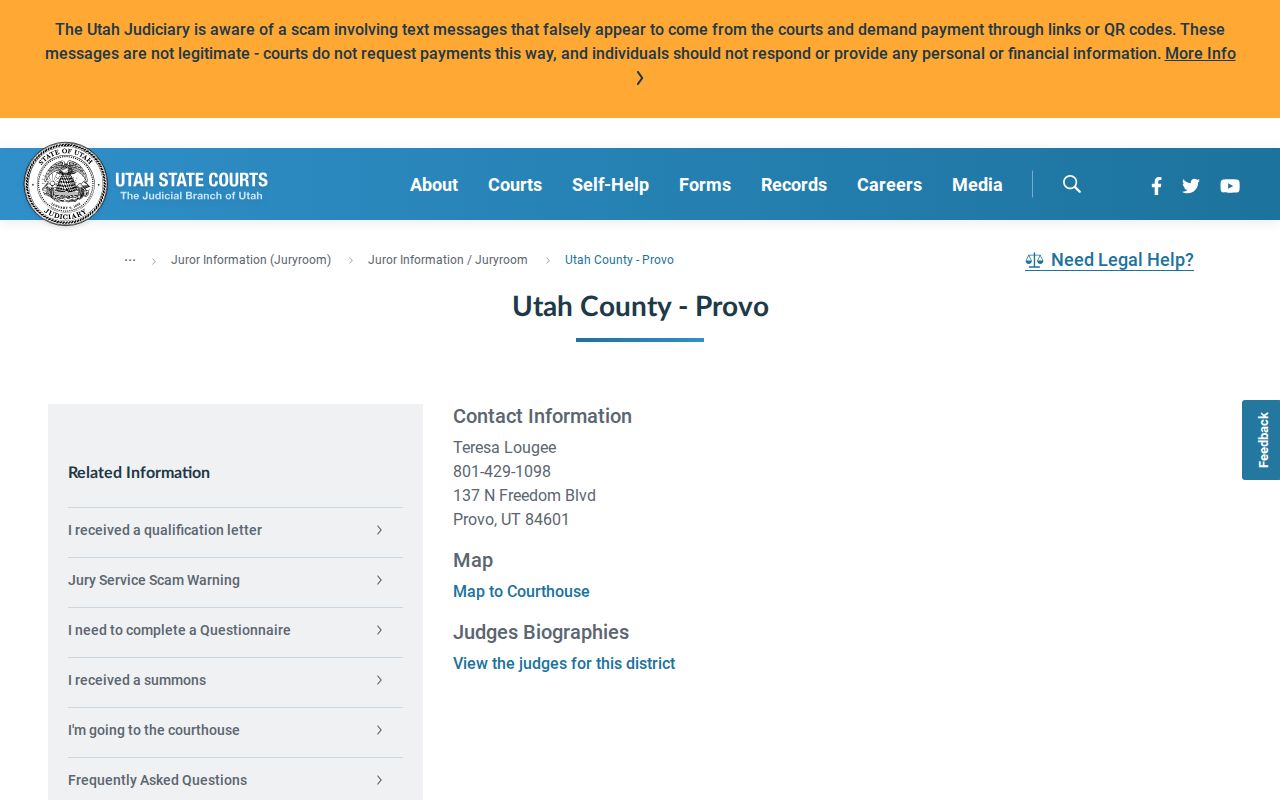
The courthouse image anchors the free-terminal option to the correct records building. A Utah County participant seeking their own eligible case may instead use free MyCase for history, documents, scheduled hearings, balances, and payments. MyCase requires authenticated party access; it is not a public name search. Nonparties should use Xchange, the courthouse terminal, or the clerk.
Inside a Utah County Case File
A Utah County criminal case file connects the formal accusation to the final result. Xchange results identify the county, court location, case type, case number, filing date, party name, birth date when available, and links to history or documents. The expanded view can show the assigned judge, attorneys, charges, plea details, hearings, events, minute entries, judgments, and accounting. Public district electronic filings made since July 1, 2010 may be bought online. Justice court document images are not promised.
| Case Number and Court | Identifies the filing year, court location, and case type needed to match the correct Utah County record. |
|---|---|
| Charging Document | A complaint, information, or indictment states formal allegations; it does not prove them. |
| Charges | Shows description, level, special attributes, plea, and charge-level disposition data. |
| Docket Entries | Tracks filings, minute entries, motions, orders, and other events over time. |
| Hearings | Lists scheduled or completed court events and may identify the assigned judge. |
| Disposition and Judgment | States the outcome, such as conviction, dismissal, or acquittal, and supplies the best answer to what happened. |
| Sentence and Conditions | Records the court-imposed result after conviction, including custody, probation, fines, or related terms when entered. |
Reading Utah County Case History
The Xchange help and anonymized sample demonstrates how charges appear before the long event history. It also shows that a plea date, a plea nature, a disposition date, and a disposition nature answer different questions.
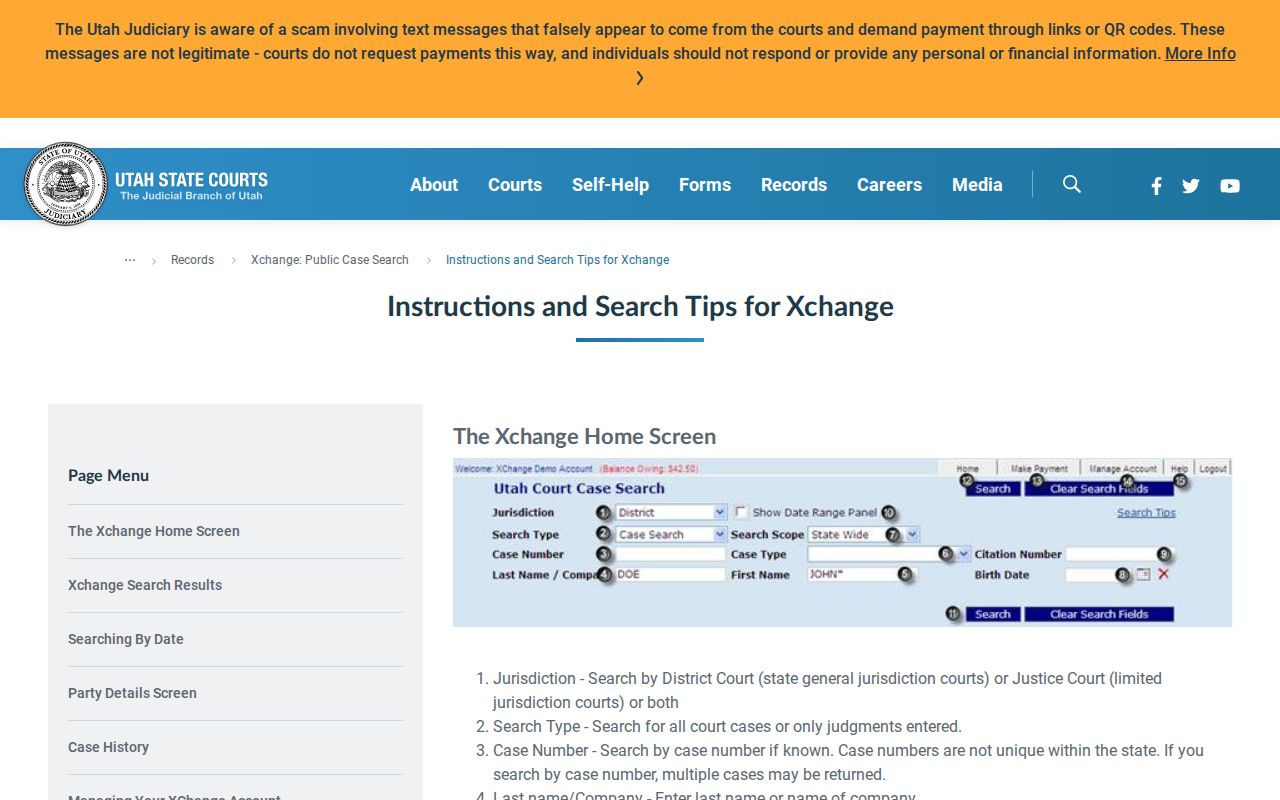
The help image uses official sample data rather than a private person’s file. Read extended history in date order. “Bound over” means a felony passed the probable-cause stage toward district court. It is not a conviction. A plea in abeyance is held while conditions are met and may later lead to dismissal. A disposition is the recorded outcome, while a judgment is the court’s formal adjudication or order. Those terms prevent a Utah County criminal court entry from being mistaken for a final guilty finding.
- Bindover
- Progression after the felony probable-cause stage, not a guilty verdict.
- Arraignment
- The formal charge and plea stage after the required preliminary processing.
- Plea in abeyance
- A Utah plea held under conditions with a chance of later dismissal.
- Disposition
- The outcome assigned to a charge or case.
- Judgment
- The court’s formal adjudication or order, often needed for certified proof.
How a Criminal Case Moves
A Utah County criminal case may start with arrest or citation, but court history begins when a complaint or information is filed. Felony matters include a preliminary hearing and possible bindover before arraignment. Motions, negotiation, trial, or a plea can follow. Each charge may then receive its own disposition, judgment, and sentence. Appeals and later motions add more entries. The exact path varies, so the sequence should be read as a map rather than a promise that every case uses every stage.
Case flow: Charges Filed → Arraignment → Pretrial → Plea or Trial → Disposition → Sentencing
A prior Utah County arrest lookup may list different intake charges, but the criminal case file remains the outcome source.
Utah County Charge Levels
Utah County charge classification helps identify the likely court before searching. Utah District Court in the Fourth Judicial District receives capital and felony cases plus class A misdemeanors. Utah County justice courts receive many class B and class C misdemeanors and infractions. The charged statute and judgment control, not a shorthand booking caption. Utah felony sentences are generally indeterminate, and probation, parole, enhancements, credit, and concurrent or consecutive terms can change actual time served.
| Charge class | General imprisonment range | Utah County venue |
|---|---|---|
| First-degree felony | Five years to life unless the offense provides otherwise | Fourth District Court |
| Second-degree felony | One to 15 years | Fourth District Court |
| Third-degree felony | Zero to five years | Fourth District Court |
| Class A misdemeanor | No more than 364 days | Fourth District Court |
| Class B misdemeanor | No more than six months | Justice court |
| Class C misdemeanor | No more than 90 days | Justice court |
| Infraction | No imprisonment | Justice court |
Case Record Access & Restrictions
Utah court records follow the judicial classification rules rather than the Sheriff’s GRAMA process. Public Xchange access does not include sealed or expunged matters, juvenile delinquency, child-welfare cases, or termination cases. Private identifiers and victim or minor information may also be withheld. Under Utah’s Government Records Access and Management Act, agency records can be public, private, controlled, or protected, but that law does not turn every police file into a court record. Start with the office that created the material.
If a Utah County criminal court case should be public but does not appear, check spelling, court scope, filing year, and case type. Then contact the originating clerk. Records more than 50 years old may have moved to Utah State Archives. A participant can test MyCase, while a public requester can use the judiciary’s record-request route. An absent Xchange entry does not establish that no case exists.
Older Utah County Court Records
The Utah Courts record-request page is the fallback for a Utah County file that is older, absent online, or needed in certified form.
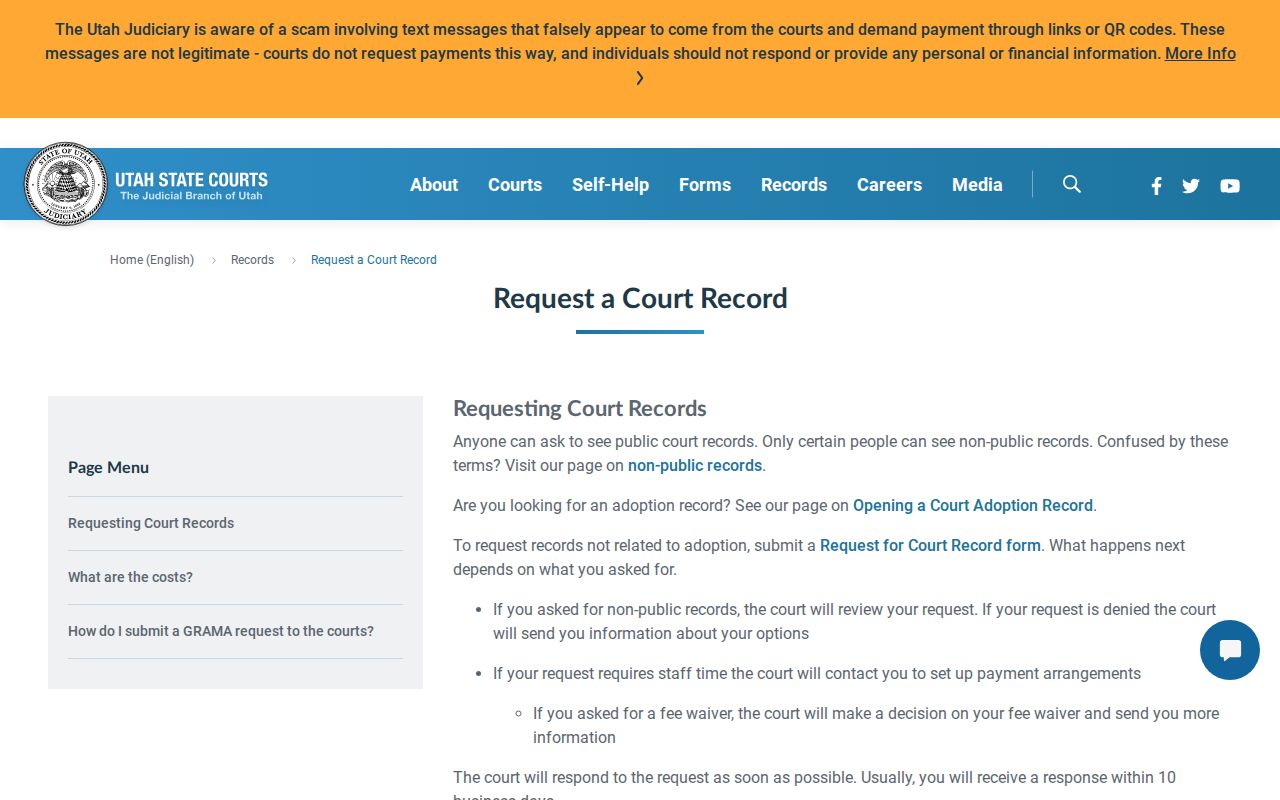
The request image marks the correct judiciary route, which is separate from a Sheriff NextRequest or agency GRAMA submission. Describe the Utah County court, case number, party, approximate date, and exact document when known. Court fees can include paper copies, electronic media, staff research after the first free period, and certification. A certified copy costs more than a plain copy because the clerk attests to it.
Utah Courts also explains CORIS terminal coverage and the district-versus-justice court split.
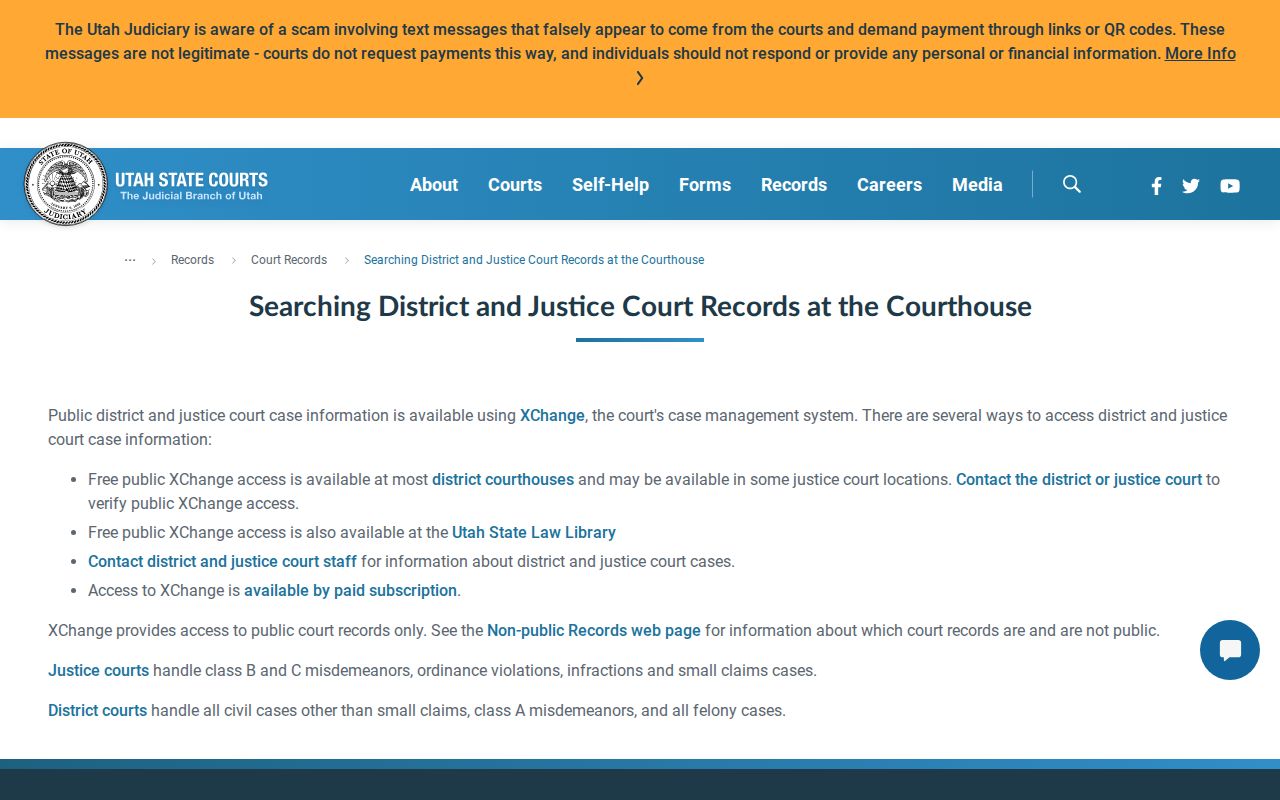
The CORIS image reinforces that court location and conversion history affect what a Utah County case search returns. For a wrong or incomplete BCI outcome, obtain the certified disposition from the originating court before using BCI’s fingerprint-supported challenge process.
Note: Court-file requests go to Utah Courts; police and booking requests go to the agency that created those records.